Tuesday, 13 September 2011

Boats lapbook

Having seen Preschool Post's boats lesson plan I decided that it would make a good next unit for Iona over the summer, so we began our next lapbook on 15th August. 

The theme of boats fitted well with lots of Bible stories, so over the fortnight we covered Noah, Jonah, Jesus calls the fishermen, the big catch, the storm on the lake, Jesus walks on the water, the parable of the dragnet, and Paul's travels.


The lapbook itself began with a dot-to-dot picture of a yacht . Iona still needs hand-over-hand help with dot-to-dots, but enjoyed both doing it and colouring the result.


Iona is now starting to try to draw over lines a lot more, so I liked the "B" worksheet that I got from First-School:

She's getting a lot better at "writing" as opposed to just colouring over the lines, but there's still a lot of work to be done. However, she's at that stage where she doesn't want me to help her a lot of the time, especially with "writing", so she'll just have to get the hang of it herself. She's also getting better at recognising initial letter sounds, which this worksheet helped with.

Underneath the worksheet I put an accordion mini-book that I made containing photos of meals that I had made on the theme of boats:
Jacket potato boats
Courgette boats


"Jesus walking on the water jelly"
"Jesus walking on the water from boat" jelly
The jellies, in particular, were very popular. Unfortunately, I've lost the reference to where I found the idea, so apologies if the idea was yours (please send me a reference to add in here if so). The jelly should have been blue raspberry, but I couldn't find any anywhere, so I used lemon and lime with copious amounts of blue food colouring, which worked very well. The peach boat was my idea, as we had some sitting around.

Rather than concentrate on initial sounds with this lapbook I decided to work more with Iona on rimes (see Oxford Reading Tree "Rhyme and Analogy"). I therefore worked collaboratively with her to make up a poem using the "-oat" rime:


At this stage she can correctly identify rhymes about 50-70% of the time, maybe more, so I think she's getting the idea, but sometimes she gets a bit overenthusiastic and comes up with entirely wrong rhymes. I liked the way she was keen to illustrate the poem, with just a bit of prompting (and drawing of the moat) by me.

We talked a little about the history of boats, and I found some colouring pictures of boats from different eras (from DLTK). I cut them out and asked Iona to put them in order of age. However, she found this very difficult, and didn't seem to have much idea. She enjoyed adding a little colouring to them, though.


To begin to develop some awareness of geography we visited a local river that runs through our town and I have reinforced its name several times since. I drew a map of our county and put the river on it, then stuck it in a small book with a map of all of England's major rivers on the front.


A further aspect of history that we covered was the sinking of the Titanic. We found a little about it in one of the general boat books that we looked through, so I then got Survivors: The Night the Titanic Sank from the library. It was a good way of talking about the history through a fictionalised story (with a happy ending!). I found this colouring page on Free Kids Coloring, and just added a few facts to remind Iona of the story in the future. She took in the story quite well, and played shipwrecks with her toys for quite a few days afterwards. We also added the sinking of the Titanic to the time line that we have going up the stairs.


For the science component of the unit we used this file folder game from File Folder Fun. As it was sunny, warm weather we were able to turn it into a water play session outdoors, which Iona loved. To try to duplicate the scientific method I asked her to predict before we played which items would sink and which would float, then we compared her predictions with the actual results. As it turned out, she predicted most items correctly.

Iona's predictions
Actual results

Testing what floats
Water play after the hard work
We also read through Fourways Farm: Floating and Sinking, which reinforced the ideas in a light-hearted way.

Further science teaching was provided by this idea from Camo and Bows, showing how water runs downhill. It was good fun to try, using a long strip of foil to recreate a river, but without a hosepipe it was a bit of a damp squib. Daddy helped for a while, by tipping the watering can while I took photos, but it would definitely have been better with a continuous stream of water. Iona seemed to enjoy it, anyway.


We also read through the section of The Earth: The Geography of Our World relating to rivers; most of it probably went over Iona's head but it was a good introduction to the idea.

The idea below came from DLTK, where it was suggested as a way to introduce the concept of halves. Iona concentrated well on it, and it was a useful way to revise shapes, as we haven't done much on them lately and she seems to have forgotten them a bit.


While doing this unit we went to an unrelated event at our local museum, where we happened to see a Bronze Age boat, carved out of a tree.


They provided a colouring station, with an artist's impression of the boat in use, so that made a useful addition to the lapbook.


There were loads of suitable story books relevant to this unit. One thing I did was re-read Iona the tale of the Jumblies, which we have in an anthology, and she began to remember the chorus. We also read, for the first time, Where the Wild Things Are, which she really enjoyed. Other books we read were Mr. Gumpy's Outing, Captain Small Pig, and We're Sailing Down the Nile (good for a bit more world geography).

Sunday, 14 August 2011

Jobs lapbook

2 or 3 weeks ago I reached the story of Moses' call with Iona in her morning Bible stories. This led to me telling her about God having a good plan for her life, so I made her a colouring sheet about jobs (the pictures came from DLTK).
Unfortunately, Iona is currently at the stage where she doesn't tend to want to do what I suggest, so not much colouring got done! However, it gave me inspiration for her next lapbook - a 2-week unit on jobs, which she's quite enjoyed.

When we put the lapbook together Iona was the most interested she's been in the process, and insisted on helping to decorate the covers, front and back!
We borrowed various books about jobs from the library, and used them to make mini books about what different professions did:
Where possible, I asked Iona to come up with ideas, after reading each book, of what the person did. As you can see from the first page of the police book, I must admit to using the police as a bit of a threat to her when we're getting in the car! I put that in the book, though, as it was her own words, which is the most involved she's been in any lapbooking.
I was very impressed by how carefully she coloured some of the police book, and even added a lollipop lady to my lollipop sign, as well as adding an RSPCA inspector to the front of that book.
Over the 2 weeks of the unit I tried to theme Iona's Bible readings around jobs, so at the end I made her a quiz of matching the character with their job. She didn't really answer any of them correctly, but I think that was because she wasn't really interested in the activity at the time. This is quite a problem at the moment, when I'm trying to encourage Iona to learn more around specific topics, and particularly when I try to use the "Teach Your Baby to Read" flashcards with her; she appears uninterested and gives silly answers which I think she knows are wrong.
The last page of the lapbook was an attempt to encourage Iona to write. When she gets magazines these days she seems to enjoy "colouring in" large letters which are outlined to encourage children to write over them, so I attempted to reproduce this. I asked her what Daddy did, and what she wanted to do when she grew up (the answer to the latter varies from day to day), then asked her to write over the words, but apart from the "i" in "fairy" she point-blank refused.
One of the Bible stories we read was the wise and the foolish man (builders), so I suggested we make a collage from torn pieces of tissue paper and egg box on a picture I drew. Again, I ended up doing most of the work, although Iona was interested; she preferred to draw her own pictures of things she was interested in at that moment. However, she enjoyed tearing the egg box, and did stick some down. She also agreed to me putting it up on her wall afterwards (sometimes she gets very worked up about me not doing that because she wants to keep working on it, i.e. destroying what's already been done).
Interestingly, although Iona seemed to enjoy and learn from this unit, it had most of an effect on me. For one thing, I am now learning to plan our work more. I recently read a very interesting post on Unit Studies by Amanda Bennett on planning your year with unit studies, and decided to timetable at least some projects at times of the year when I know we are likely to want to do them. This has had the very useful effect of focusing what I do with Iona into a discrete period. In this case, for example, I restricted us to 2 weeks on jobs, so when I reached the end of the second week I forced myself to tie up the lapbook with Iona, despite not having covered all the jobs or books that I'd planned to. What we did seems to have been enough for her, and we didn't end up this time with the unit dragging on and on, so I will try to continue working like this.

Secondly, and most importantly, I realised, after doing Bible studies with Iona stressing that God has a plan for her life, and discussing with her what she could do when she grows up, that it really doesn't matter to me what she does. Previously I've given lip service to the idea that the most important thing is to serve God, whatever he asks of her, but privately I felt I would be deeply disappointed if she didn't go to university. However, since doing this unit I really do feel now that, although I'd still like her to go to university, it really doesn't matter if she doesn't, as God's plan for her is a good one.

Monday, 27 June 2011

1970's lapbook part 1

Last month I discovered my old Sindys, Pippas and Barbie in a box we'd had in the loft. I decided that Iona was now old enough to play with some of them, although I didn't feel I could trust her with my beloved Sindys or proper Pippas, so I gave her the spare clothes, and Barbie (who was a late addition to my family) and a couple of imitation Pippas:
Iona was absolutely thrilled, and loved trying to dress (but mainly undress) the dolls:
We talked about how different the clothes were from those we wear today, and Iona quickly learned the word "flares"! This led me to think "Why don't we do a lapbook about the 1970's!".

We started off by putting "Mummy's Pippas and Barbie" under the 1970's on our timeline which leads up the stairs. I also bought our own copy of a book which Iona loved to bits when we borrowed it from the library some months ago, Before I Was Your Mother, as it talks about a little girl's mother being a little girl, as I was in the 1970's.

We did various activities, which I will detail later, then yesterday, when reading another library book about the '70's with Iona, I was reminded that decimal currency was brought in in 1971. I explained to her that the coins we use were first used in the 1970's, and showed her how to make coin rubbings. We've talked about money a bit before, usually when checking what's in her piggy bank, but this is the first time that I've systematically shown her all the coins (except 10p, which we couldn't find one of anywhere in the house). She really enjoyed making rubbings of all the coins, although she needed a lot of help to cover each one - if I hadn't stepped in we would just have had circle shapes vaguely around each one. Today, I decided I wanted to make her a set of 1p coins that we could use to play shopping. In order to help her in identifying real coins I tried to make them as realistic as possible. I got a sheet of thick card, drew around a real 1p ten times on it, drew the 1p design on them, front and back, coloured them with a brown crayon, then cut them out. To stop Iona drawing on them (which she was keen to do), and to make them last a bit longer, I wrapped them in sticky tape. Iona was very pleased with them, and insisted on spending the evening "buying" things from me, which was good practice for her counting skills as I made her give me the correct number of 1p's for whatever price I quoted up to 10p. I considered using real 1p coins for this activity, but at such a tender age Iona is already very aware that money is valuable, and wants as much as she can keep for her piggy bank! Of course, I could use coins from said money box, but then I was concerned that, once playing with them, she might forget their value and insist on keeping them in one of her toy boxes, bags, etc. and that we'd end up losing them. Overall, I think I made the right decision to make cardboard coins, and so far I'm very pleased with the result.

Tuesday, 21 June 2011

A wonderful poem

Someone posted this GK Chesterton poem on the Early Years HE yahoo group last week, and it expressed my feelings so well I just had to repost it:

Songs of Education
III. For the Creche
Form 8277059, Sub-Section K

I remember my mother, the day that we met,
A thing I shall never entirely forget;
And I toy with the fancy that, young as I am,
I should know her again if we met in a tram.
But mother is happy in turning a crank
That increases the balance in somebody's bank;
And I feel satisfaction that mother is free
From the sinister task of attending to me.

They have brightened our room, that is spacious and cool,
With diagrams used in the Idiot School,
And Books for the Blind that will teach us to see;
But mother is happy, for mother is free.
For mother is dancing up forty-eight floors,
For love of the Leeds International Stores,
And the flame of that faith might perhaps have grown cold,
With the care of a baby of seven weeks old.

For mother is happy in greasing a wheel
For somebody else, who is cornering Steel;
And though our one meeting was not very long,
She took the occasion to sing me this song:
"O, hush thee, my baby, the time will soon come
When thy sleep will be broken with hooting and hum;
There are handles want turning and turning all day,
And knobs to be pressed in the usual way;

O, hush thee, my baby, take rest while I croon,
For Progress comes early, and Freedom too soon."

- Gilbert Keith Chesterton

Saturday, 18 June 2011

Well dressing

Today was a busy but interesting day. Firstly, I took Iona to a local fire station, which was having an open day. She was very excited when I told her she was going there, as she's fascinated by all sorts of alarms, and also emergency vehicles. Once there she was shocked by the display of what happens when you pour a cupful of water over a small chip pan fire (to be fair, so was I even!), and refused to go anywhere near any other displays. However, she loved seeing the fire engines and was very interested in everything, asking me a couple of questions to which I didn't know the answer and which I had to collar a fire fighter to answer for her. All good practice for her at learning from others in the community.
After that, we rushed into an arts centre in town, who were having a do-it-yourself mini well dressing session for children. For those who don't know (as I didn't before I moved here), well dressing is a tradition from the Midlands of England which is said to have arisen as a way of giving thanks to God for safe water in a time of the Black Death (see this article in Wikipedia). We managed to arrive half an hour before the end, and had a lovely time with a very helpful lady. For only £1GBP we were given a tray of terracotta clay and access to loads of materials, as well as good instructions. Iona chose a cookie cutter and helped me use it to make a teddy shape in the clay. The lady then told us to use peppercorns to outline the teddy. After I showed Iona and explained to her what to do she quickly got the hang of it, and only needed occasional reminders not to put the peppercorns outside of the line. I was surprised how accurate she mostly was, although I helped her by doing some of the outline as I think she would have got bored before it was finished. Likewise, with the red gravel, I helped her to fill some of it in, but again she didn't need much correction. Finally, Iona was able to choose her own flowers to outline the teddy, and she was able to pull the heads off and push them into the clay mostly by herself.
She was justifiably proud of the result, and I was really impressed with how well she concentrated, after quite a long afternoon already, how well she took instruction and how independent she was.
The lady who taught us said they are planning to run some more, different sessions in the summer holiday, and if they are as good and as cheap as this one was I certainly hope to take Iona to them.

Potty training as an analogy for education in general.

Well, at last Iona has begun potty training! It happened nearly 3 weeks ago, on the Monday. I'd previously tried to teach her to use the toilet, with a training seat on it, after the potty didn't seem to inspire her when she was very young. Meanwhile the potty languished in the bottom of the pile of soft toys in the living room. On the Monday morning she rediscovered the potty, said she wanted to do a wee on it, and did! Since then we've barely looked back. It took a bit longer to get the hang of doing poos in it, but she's mostly able to now, especially if I remind her where to do it. There have been a few accidents, so we've tended to put her in nappies when we're out, to be on the safe side, but overall it's been remarkably easy. She's basically potty trained herself!

All this seems to me a lot like the whole process of education. We prepared her as best we could by reading books about using the potty, talking about it, becoming comfortable around it, then when she was ready she just taught herself. In the same way, I think, especially with things like teaching reading, maybe I just need to learn to relax and trust that, if I provide every opportunity for her to learn, she will do so in her own time.

Sunday, 22 May 2011

Plants and flowers lapbook

We've finally just about finished our latest, major lapbook, at last. As it was begun in early Spring I decided it would be a good idea to look at flowers, generalising it out a bit more to plants as that was the subject of 2 science clubs while we worked on it.

We've planted a few seeds this year, which Iona helped with a little. Mostly she just liked messing around with the pots and compost, but she did help me plant the potatoes.
She has since got very "into" planting seeds, and came to me the other day with a little pot she'd found in the garden, filled with compost she'd taken from one of the spare tubs, saying she'd planted a seed! I don't know what she'd put in it, but whatever it was has started to grow (it looks a bit like a bean).

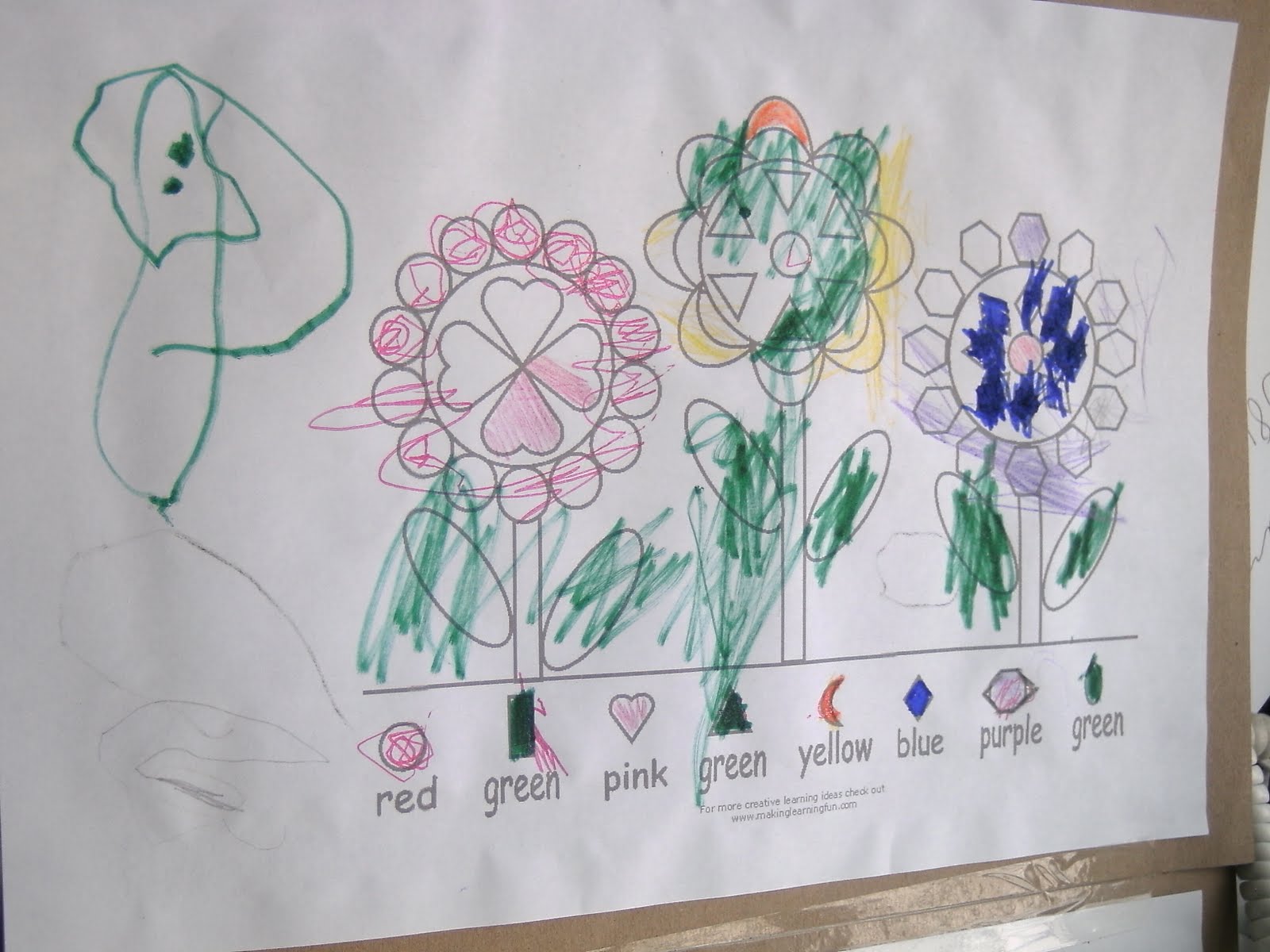
We did this rather nice activity to practise her colours (which she already knows pretty well), and her colouring, which is getting much better - I was really pleased with how she followed instructions for this activity.


Making Learning Fun also had this easy dot-to-dot which I decided to try with Iona. She can count from 1 to 10, knows the written number, and is beginning to get much better pen control, so I decided it was worth a try. However, she needed a lot of hand-over-hand help at this stage, and preferred to do her own thing.
Over the course of this unit we have looked close-up at lots of flowers, with me explaining the correct names for the parts to Iona. Although I liked the diagrams of flower parts I found online, I decided in the end that our diagram would be more meaningful to Iona if we labelled a photo of her favourite flower to dissect at the moment - the yellow poppy in our back garden, so I took a photo of one she'd brought me before she tore it apart! Unfortunately our colour printer cartridge was giving up the ghost at the time, but this enabled me to turn it into more of a line diagram with pen and ink to make it clearer.

We also made some egg box daffodils (can't remember where I got the idea from but it works really well) for Grandma for Mother's Day, and some for our next-door neighbour who was ill, so I photographed them and put the photo in the lapbook.The final piece of work on this page was a write-up of one of our dog walks to a wood where we picked a few flowers and leaves. To preserve these flowers we made our own flower press.
A really interesting book we borrowed from the library during this unit was "The World Came to My Place Today" by Dr Jo Readman and Ley Honor Roberts. It was about the different ways in which we use plants and where they're from, thus bringing in some geography. As an experiment we talked about how plants are used as dyes and decided to see how well different plants and their products dyed. I had prepared some fresh beetroot so had the water left from that, and used turmeric in water, too, as I'd read that that gave a strong colour. Iona said about the yellow petals from the poppies in our garden, which she was very interested in at the time, so we soaked some of them in some water too, to see if that would stain the material. For dyeing we used some natural-coloured cotton, and left it in the 3 solutions with either vinegar or lemon juice as a mordant overnight. As a pattern for how to write up an experiment we followed the procedure of "Guess with Jess", which is a BBC CBeebies programme that Iona loves, as I felt that it was a good demonstration of the scientific process with which Iona could identify.
We were lucky enough that, while I was on one of my dog walks next to farmland, I found some stalks of wheat that someone had pulled from the field. I had brought them home to show to Iona, so for this unit I stuck one, along with a grain of wheat, into a minibook for her.

This diagram of a tree was found on Enchanted Learning. I asked Iona the names of the parts of the tree, which she mostly knew, just calling the trunk the stem instead!
This picture that Iona coloured according to shape (with not a little prompting!) came from Making Learning Fun. I found it useful as it reinforced the shapes which Iona has been good at for some time. The only problem with it was her determination to do things her own way (which can be an advantage, of course but can still be irritating at times!).
The front of the lapbook contained various activities found on Homeschool Share and Homeschool Helper. "Will it Come Up?" was just a fun activity based around carrots growing, which was appropriate for us as Iona's been involved in growing carrots last year and this. "Parts of Plants we Eat" was a useful and interesting activity, as Iona loves her vegetables and fruit, so she was quite good at suggesting plants to me. I planned to find some photos of plants to put in here, but that never quite happened!

The pollination mini-book was surprisingly successful, as Iona and I have talked a lot about pollination, so I was able to ask her what pollination was and basically just wrote down her answer with a little embellishment.


The carrot seed rhyme was rather cute. I'd hoped to persuade Iona to do a bit of movement to it, curling up small like a seed then growing up tall, but she only watched me do it and wouldn't do it herself. She seemed to like it, though.Finally, we made a "Life Cycle of a Flower" craft from 2 paper plates and a split pin. I drew the pictures on and Iona "coloured" them in. It was inspired by this activity from Homeschool Helper.
A good book, that Iona liked, looking at plant life cycles was "Amazing Life Cycles: Plants" by Honor Head

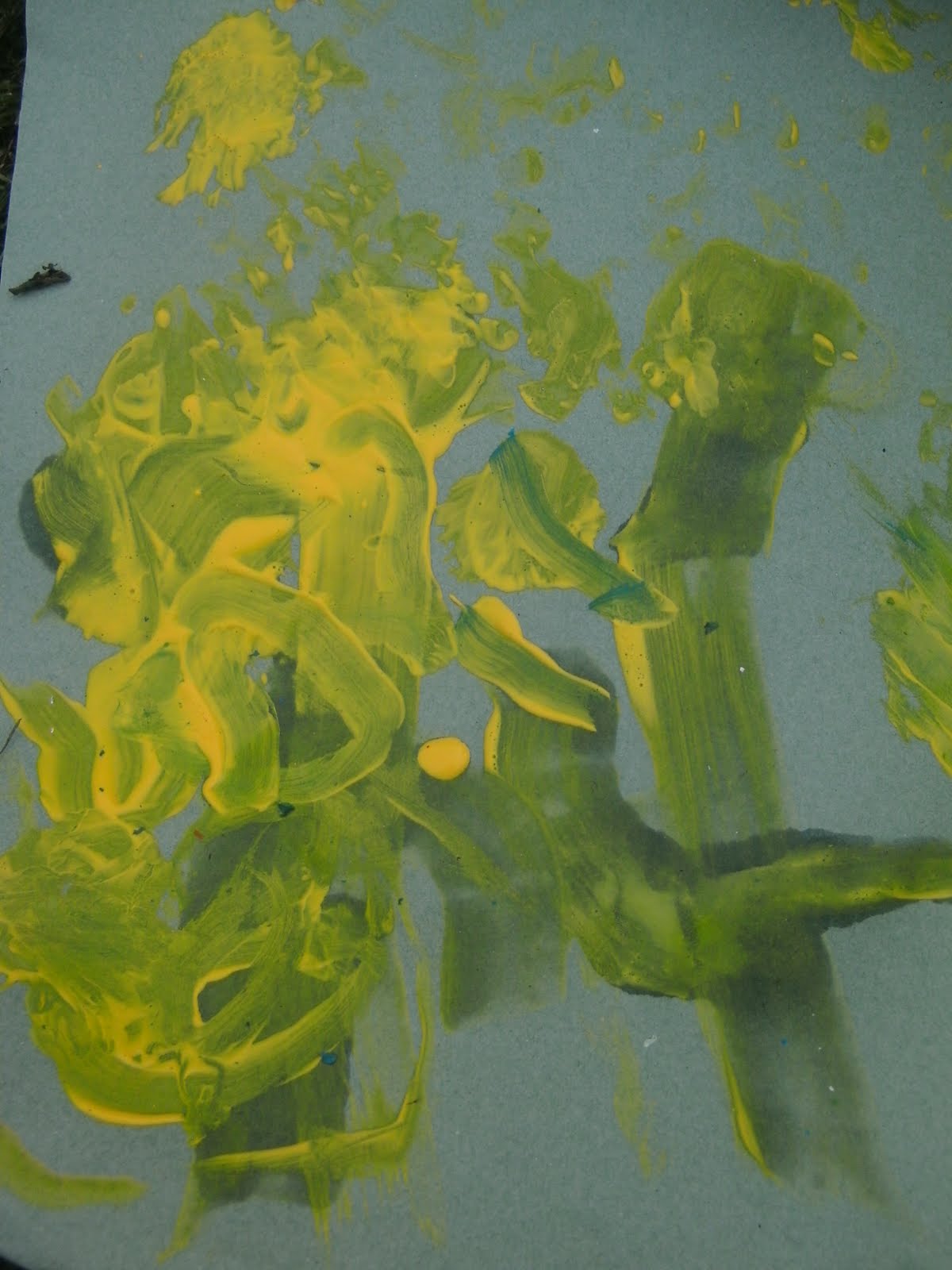
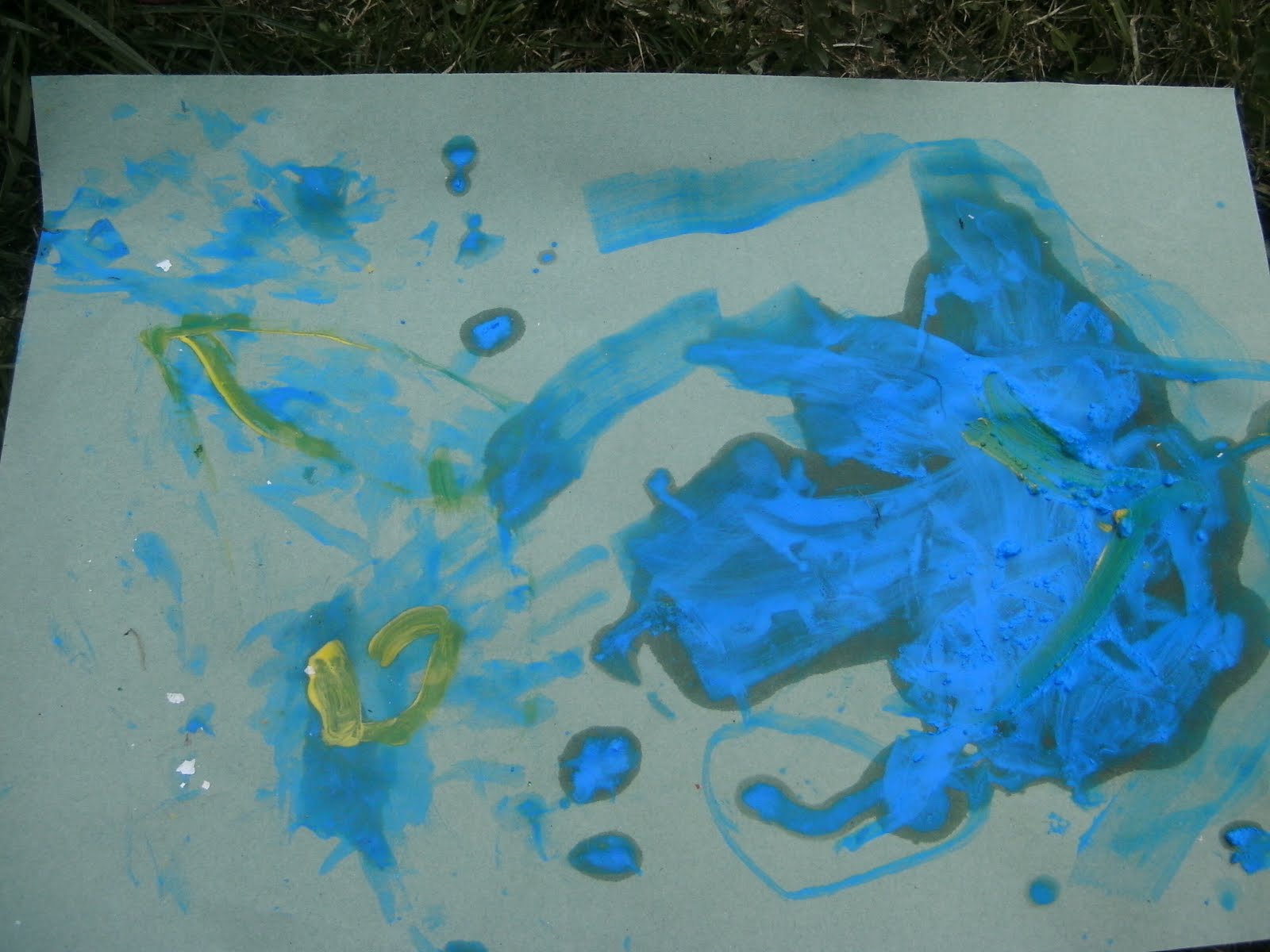
As part of this unit we looked at the work of some of the impressionists, particularly Monet's waterlilies. A book that I was really impressed by (pardon the pun!) to introduce this subject was "Katie and the Waterlily Pond" by James Mayhew, which we borrowed from our local library. We also tried "At the Time of Renoir" by Antony Mason,which was too detailed to read to her but was good to show a variety of styles and artists within impressionism. After reading through these and describing the idea of impressionism to Iona as best I could, I worked with her to try to produce our own impressionist paintings of flowers. I chose dandelions and bluebells, as they happened to be out at the time, and showed her one flower of each to paint. The results were probably nothing special, but at least this time, having only given her one colour paint at a time, they were a colour other than muddy brown! After I'd tried to teach her to look at the flowers to paint them, I wondered what the results would be if we used a flower to print with, so I gave her the dandelion and the resulting picture was interesting:
This was Mummy's attempt, using printing and splatter painting:
Finally, 2 other books that Iona and I really enjoyed on the subject of plants, again from out local library, were "First-Hand Plants and Flowers" by Lynn Huggins-Cooper, which had a nice story aspect to it, and "All Kinds of Plants" by Carrie Branigan and Richard Dunne, which had good clear diagrams, just at the right level, and covered a wide range of topics.

Drawing progress

I can't get over how quickly Iona is growing up. It seems only a matter of weeks since she was doing random squiggles on paper, though she would tell us that they were of particular things. Suddenly, at Sunday School one week, she put 3 dots resembling eyes and nose on a blank face shape:
Was I imagining it?! Apparently not, as a few weeks later, on 14th April, she produced these faces:

3 days later, she added some hair and legs (although got slightly confused with the number of mouths!):
2 days later she surprised me once again, by producing people with eyes, noses, mouths, hair, arms and legs:

She sometimes since has added circles for cheeks, and will sometimes put some for ears, although lately she has taken to making the eyes a little less complex and just doing them as dots. I presume this is because her attention is now being drawn to detail elsewhere.

Within the last 3 weeks she has started trying to draw animals. This began spontaneously on 2nd May when she drew this elephant:
Notice the ears either side of the head and the long trunk in the middle. She has since drawn a lion and a tiger on birthday cards for friends, although I didn't think to photograph them. I reminded her what she needed to put on, but the lion had a lovely mane, while the tiger had definite stripes.

The final picture here follows her birthday, when she had several cakes and candles in one week. She told me she was drawing a birthday cake, and drew the top shape as a cake with candles. She then drew another cake at the bottom of the page, and surrounded it by people, saying it was Iona, Mummy and Daddy with a birthday cake:

Friday, 22 April 2011

My little flower

Having finished our Kings and Queens lapbook I was a bit stuck for our next topic. At the time, it was a bit early to start on Easter, so after a little discussion with Iona I decided it was appropriate to look at Flowers and Plants. This was partly because Iona is a very "flowery" girl sometimes, and partly because the home education science group is doing a couple of weeks on plants, so we'd done a little work on plants anyway.

This has been much easier to find resources for than many of our previous topics, and, in fact, it can be quite hard narrowing it down to a smallish number of things so as not to overwhelm (and bore) her. It will be rather hard to put any photos on of our work for a while (which is a pity, as I've been taking loads!), as my laptop seems to have been dropped once too often and the fan isn't working any more, it's the only computer I've got my camera software on, and I can't find the disk for the software to load it onto the desktop!

Anyway, the first thing we did about plants was to show uptake of water by celery stalks by cutting one in half lengthwise up to about halfway up the stalk, then put each half into a cup of water to which quite a few drops of food colouring had been added, a different colour in each cup. Within about an hour the leaves had begun to take on the colour of the food colouring on that side, and by the next morning we had a beautiful 2-colour piece of celery. I took it to the science group and was able to cut a slice and make into a slide to look at under the microscope. At the science group we concentrated on plant structure and made quite a few slides of different parts of plants, as well as looking at them under a magnifying glass. Iona wasn't particularly interested in this, though, and spent most of the morning playing in the garden or with a train set in the other room, while I helped the older children. It did, however, make her more interested in magnifying glasses, which she's often wanting to play with at home now.

Since the group, a couple of weeks ago, I have concentrated a lot more on teaching Iona the parts of plants, and she's become fascinated by that, and quite good at remembering them (well, petals at least). She's also getting a good understanding of pollination, and the other day, when we were playing in the garden, was going around saying thank you to the bees for pollinating the flowers! We've made a little mini-book about pollination, with her helping me to actually write the text. I printed this from Homeschool Helper Online, along with quite a few of their other ideas. I haven't used that many of them yet, but one thing I did do, using 2 paper plates joined with a split pin, is make a wheel showing the life cycle of a flower, which Iona enjoyed helping to colour.

Another of our early flower and plant activities was planting vegetable seeds, and activity which Iona loved last year and is even more keen on this year. Since the weather got nice enough to play outside she's been playing with the compost in the pots, and this week she finally got to help me plant the chitted seed potatoes. She was a bit over-keen on this, and kept trying to add more to the pots, so I had to try to explain about them needing enough room to grow. She also has her own pumpkin seedlings, as an open farm near us was advertising pumpkin seed planting from a couple of weeks ago. When we got there they had to find someone to set the activity up for us and then, as with so many children her age, Iona turned shy and wouldn't interact with the woman at all - I had to plant the seeds for her! It was most embarrassing, especially as they didn't charge us anything! Iona enjoyed the outing, though (as they had a nice play area!), and has been happy helping to look after and at her little seedings since.

We've also had a bit of a field trip, as the woods where I take the dog for walks is a beautiful bluebell wood at the moment, so I took Iona with us the other day. She loves going there and is so adventurous, exploring the undergrowth while I tell her stories about her being a princess "battling through the deep, dark forest". She wasn't particularly excited by the flowers, although we picked 1 of each of the types we saw, as well as a few leaves, to stick in a mini-book about her walk. Yesterday we made a flower press, using instructions from Disney's Family Fun site, and put the flowers and leaves into that. I'm looking forward to the convenience of using this plenty, rather than having to pile heavy books on top of layers of tissue and flowers.

I think I'd better leave it at this, but hopefully in my next post I'll look at some of the books we've been reading on the theme of flowers and plants.